
Technology & AI · 6 MIN READ
Where to start with AI in a small business
A useful first step is closer than you think. Find one recurring task, give it a clear boundary, and build a practice your team can trust.
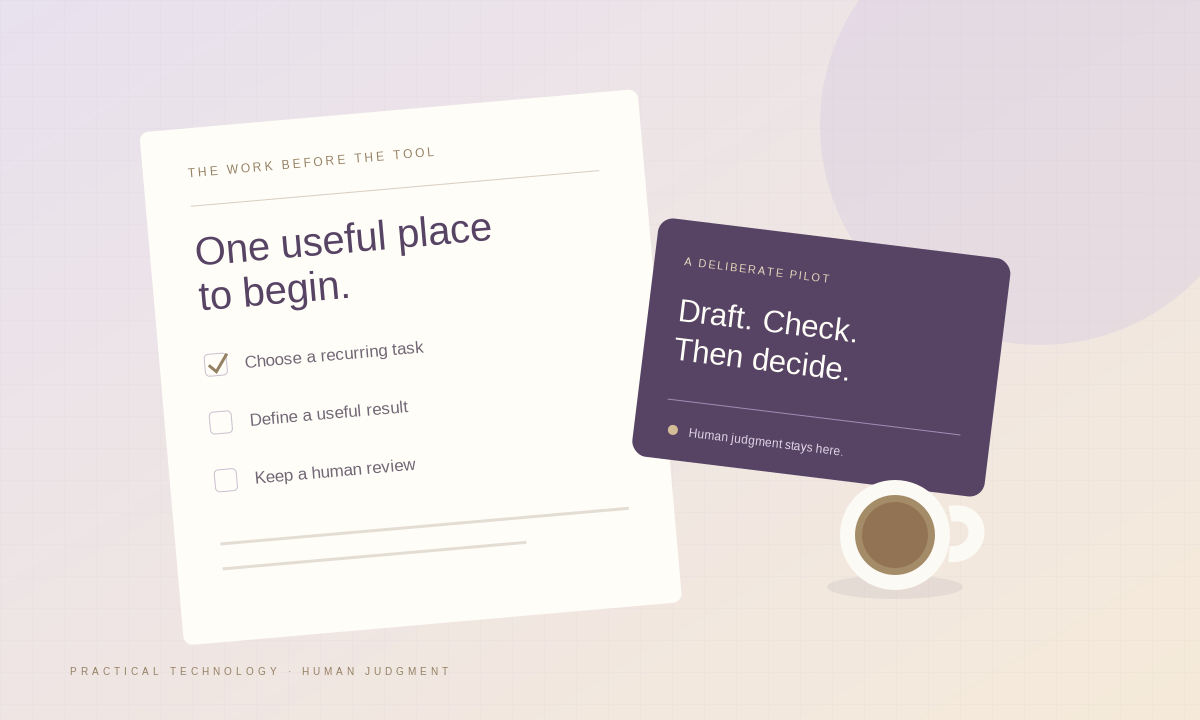
The question often arrives at the end of an already full day: should we be doing more with AI? You have seen the demonstrations. Someone is producing content faster, answering questions instantly, or connecting a collection of tools that seems to run itself. Meanwhile, your own business still has proposals waiting for review, meeting notes scattered across documents, and a process that works largely because one person remembers what happens next.
You do not need to rebuild the business to begin. A more useful starting point is a recurring piece of work that you understand well enough to evaluate. The goal is not to make the most impressive demonstration. It is to discover whether a tool can improve a real task without creating a larger checking, privacy, or coordination problem. That is a business decision first and a technology decision second.
Find the work that keeps coming back
Before comparing software, look at an ordinary week. Notice the work your team repeats: turning meeting notes into action lists, preparing an outline for a familiar document, sorting a list of internal questions, or adapting approved information for a different audience. Write down the starting material, the finished result, the person responsible, and the person who checks it. If nobody can describe those things, the task needs clarification before it needs AI.
Choose a candidate with a limited consequence if the first attempt is wrong. Drafting a non-sensitive internal agenda is easier to supervise than sending an unreviewed client recommendation. A task can be frequent without being suitable. Work involving hiring decisions, confidential records, legal obligations, money movement, or safety needs a different level of assessment. For an initial exercise, keep the tool away from decisions it has not earned permission to make.
Decide what a useful result looks like
A vague instruction such as “make this better” gives you very little to assess. Instead, define the output in language a colleague could follow. Perhaps the meeting summary must identify decisions, separate open questions from assigned actions, and leave a blank wherever an owner was not agreed. Perhaps a proposal outline must use your existing headings and avoid inventing a price. The requirements should reflect the way your business actually works.
Keep one or two approved examples nearby, along with a short review checklist. Ask whether the result preserves meaning, follows the required structure, and makes uncertainty visible. An output that sounds polished but silently changes a deadline is not an improvement. This is also where your judgment becomes a reusable asset: the standard you explain to the tool can become a clearer standard for the people using it.
Set information boundaries before the first prompt
Start your experiment with invented or carefully redacted material. You can learn a great deal from a fictional meeting or a sample brief without uploading a client conversation. Before using real information, establish which material may enter the selected service, who can access it, and whether you have authority to share it. Review the provider’s current terms and settings for retention, model training, account controls, and deletion rather than assuming all AI tools handle information alike.
NIST’s Generative AI Profile identifies risks including data privacy and confidently incorrect output. Those are useful reminders to design a boundary, not reasons to abandon every experiment. In practice, separate public reference material from internal information and restricted records. Give staff a straightforward escalation path when they are unsure. A tool that can accept a file has not established that your business should upload it.
Read NIST’s Generative AI ProfileKeep a person responsible for the handoff
Imagine a small service business preparing a weekly project update. A team member provides approved, non-sensitive notes. AI organizes them into a draft with progress, questions, and next steps. The project owner checks the facts against the original notes, removes any invented conclusion, and decides what the client should receive. The system has helped arrange the work; it has not acquired authority to speak for the business.
Make that review a named step instead of an informal expectation. Identify who can approve the output, what they must inspect, and what happens if they are unavailable. Where possible, keep source notes beside the draft so checking does not become a search exercise. Do not connect automatic sending merely because a draft reads well. Creating a draft and authorizing an external action are separate permissions, and they should stay separate until you have a deliberate reason to change them.
Test a small sample, including the awkward cases
Try the workflow on a small set of ordinary examples, then include the situations that tend to cause confusion. Use incomplete notes, conflicting dates, an unfamiliar abbreviation, or a request outside the agreed scope. Watch what the tool does when information is missing. Does it flag the gap, ask a question, or fill the space with a plausible answer? Your review should make those differences visible before the process touches a real client.
Keep a simple experiment record: what you supplied, what needed correction, how long review took, and whether the finished result was usable. Compare against the current method, including the time needed to prepare inputs and repair mistakes. A faster first draft may still create more work overall. It is equally reasonable to discover that a reusable template, a cleaner checklist, or a better source document solves the problem without an AI step.
YOUR FIRST PILOT
A bounded pilot: choose the task, define the standard, review the draft, then decide what to keep.
Write down what the next person needs to know
If the experiment is useful, document the version that worked. Keep the purpose, permitted inputs, example instruction, review checklist, and escalation route together. Include the limits: what the workflow must not do and which situations should stop it. A process should not depend on one person remembering a clever prompt from last Tuesday. It should be understandable enough for someone else to use and question responsibly.
Introduce the workflow as a practice session, not a surprise requirement. Let the people doing the work test it, explain where it creates friction, and improve the instructions. Establish who maintains the reference materials when a policy, product, or service changes. NIST’s AI Risk Management Framework offers a broader voluntary structure for considering risk over time. Your first pilot can be small while still having a clear owner and a regular review point.
Explore the NIST AI Risk Management FrameworkExpand because it helps, not because you can
After your trial, decide what the evidence supports. Keep the task as a supervised draft, revise the workflow, or stop using the tool for that purpose. If you continue, choose the next improvement deliberately. Better source information may matter more than another integration. Clearer responsibility may matter more than a custom assistant. There is no requirement to turn a useful experiment into a large technology project.
If you want support, begin with the work you want to understand. Coaching can help you map the task, practice responsible use, and define an adoption plan that fits your team. If that plan later needs hands-on building, implementation through Ayleana’s Enterprise can be considered separately after scope and capability are confirmed. A good first step leaves you with more clarity about your business, whether or not AI becomes part of the answer.
Sources & further reading
External sources support the specific factual guidance noted in the article. The practical examples and workflow suggestions are editorial recommendations.
MAKE IT PERSONAL
Find your first useful starting point.
Bring a recurring task or an unfinished idea. We can explore the workflow, the judgment it needs, and the support that fits.
Explore technology coachingKEEP EXPLORING
A little more perspective.
Operations & relationships · 6 min read
Automating client follow-up without losing the personal touch
Good follow-up feels considered, not constant. Build a rhythm that handles the reminders while leaving room for a real conversation.